
Alpine County Court Records After a Jail Arrest
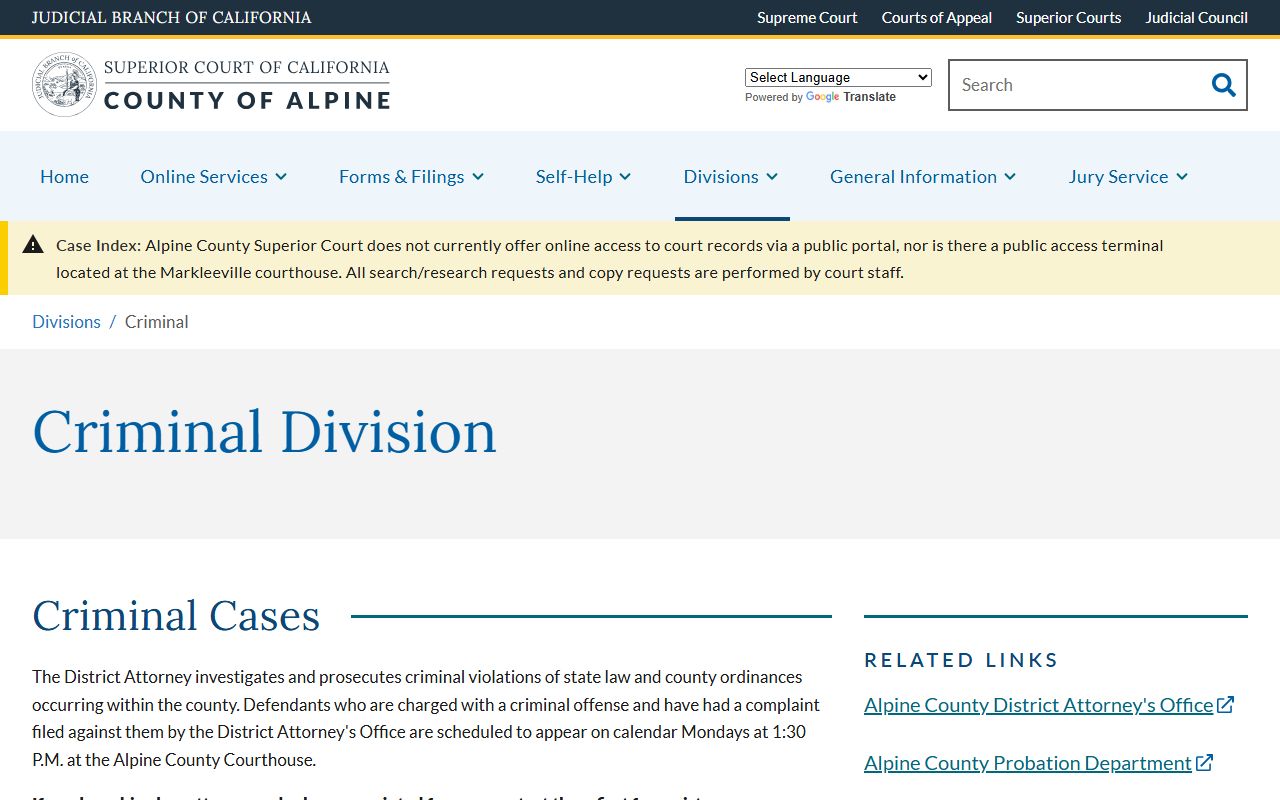
Alpine Superior Court is the local court record source for charges filed after an Alpine County arrest. Alpine County does not operate its own jail, so the first record may be an arrest or booking entry tied to Alpine Sheriff's Office, South Lake Tahoe Jail, Placerville Jail, or Calaveras County Adult Detention Facility. The court case begins later, when the Alpine County District Attorney's Office files a criminal complaint. The official court criminal division page says defendants charged with a criminal offense and with a complaint filed by the District Attorney are scheduled for the Monday criminal calendar at 1:30 p.m. at the Alpine County Courthouse.
That sequence matters because booking charges and court charges can differ. A contractor jail roster can show the charge code entered at intake, the booking number, the arresting agency, the total bail field, and a custody status. Alpine Superior Court records, by contrast, show the formal filed charge, court dates, minute orders, pleas, dispositions, and case summaries. Use jail inmate records for roster and custody details, and use jail mugshots for booking-photo questions. The court record is the case file after the arrest, not the same thing as a jail roster entry.
The Alpine Superior Court records page is the key source for the request process. The court records page explains that Alpine does not provide online access to court records and does not have a public access terminal at the Markleeville courthouse.
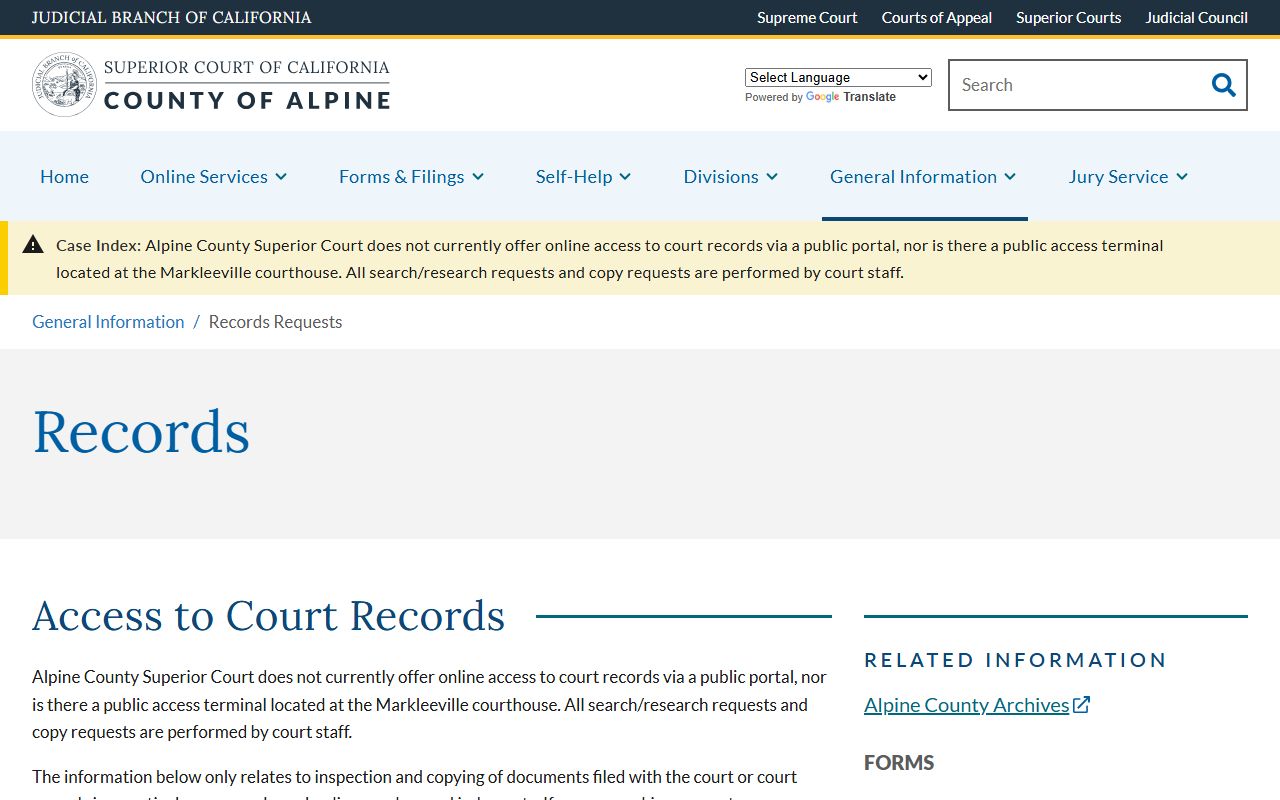
Because the court itself handles searches and copies, the most reliable path is to identify the defendant, date of birth, and case number if known, then request the specific criminal case records needed.
How to Find Alpine County Court Records After an Arrest
There is no Alpine online case search portal for the public and no public terminal at the courthouse. All search, research, and copy work is performed by court staff. Requests may be made in person, by mail, or by fax. The court does not process name search or copy requests by email. The clerk's office phone is (530) 694-2113, with published hours Monday through Friday, 8:00 a.m. to 4:30 p.m.
- Start with the custody trail. If the person was recently booked, check El Dorado County Citizen RIMS, Calaveras Citizen RIMS, or call Alpine Sheriff's Office at (530) 694-2231 to identify the housing jail.
- Do not treat the roster charge as the final court charge. The District Attorney may file a different charge, add a count, reduce a count, or decline part of the booking allegation.
- Use the Alpine Superior Court name search and records request process when the case number is unknown. Provide the person's full legal name, aliases, and date of birth. The court searches back 10 years unless another range is requested.
- Once a case number is identified, request the records that match the need, such as Register of Actions or Case Summary, Complaint, Pleas and Disposition, Minute Orders, Entire File, or other specific documents.
- Plan for timing and fees. The research file notes a $15 name search fee for searches longer than 10 minutes under Government Code section 70627(c), $0.50 per copy page, payment before search work begins, typical processing within two weeks, and another 1 to 2 weeks if records must be retrieved from off-site storage.
In-person name-search requests at the clerk's counter are not charged the search fee, but other fees still apply. Criminal name search results exclude infractions unless the requester specifically asks for them. If a request is submitted by fax or mail, include a reliable return method and payment information exactly as the court form requires.
How Court Charges Get Filed After an Alpine County Arrest
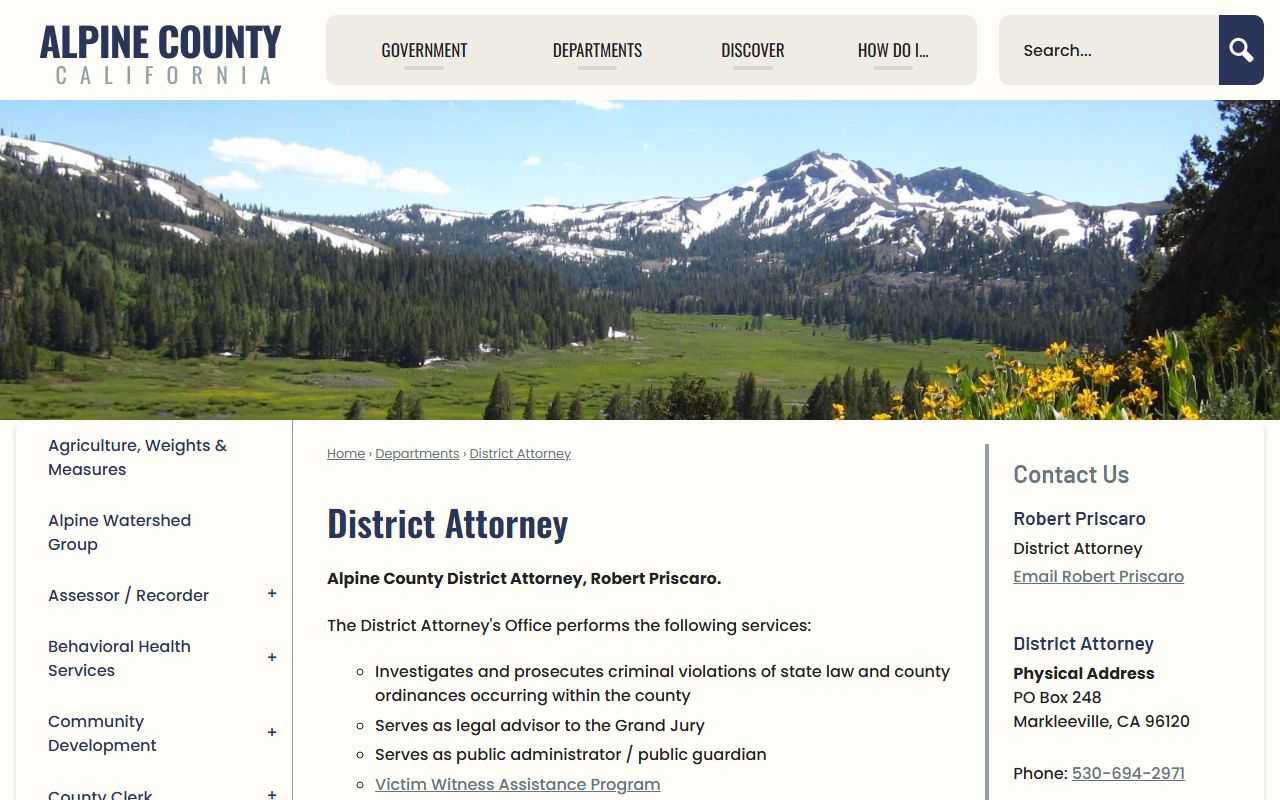
The charging document is where the court record separates from the booking record. Alpine Sheriff's Office or another officer may make the arrest, and a contractor jail may create the booking record. Robert Priscaro, the Alpine County District Attorney, heads the office that investigates and prosecutes state-law and county-ordinance violations occurring in Alpine County. When the DA files a complaint, the case enters Alpine Superior Court's criminal calendar path.
The Alpine County District Attorney page identifies District Attorney Robert Priscaro and describes the office's prosecution, Grand Jury advisory, public administrator, public guardian, and Victim Witness Assistance Program roles.
California criminal filings most often begin with a complaint in a small county case. Other charging documents can appear depending on the case posture, felony procedure, or grand jury action.
| Complaint | Information | Indictment | |
|---|---|---|---|
| Filed By | District Attorney | District Attorney after qualifying felony procedure | Grand Jury |
| Common For | Misdemeanors and many initial felony filings | Felony cases that proceed past preliminary steps | Serious or grand-jury-presented cases |
| Starts | The formal court case after arrest or citation | A later felony trial-court pleading path | A case based on grand jury accusation |
Charge Status in Court Records After an Arrest
Charge status changes as a case moves. The jail may display an arresting charge from intake, but the court file reflects what the prosecutor filed and what the judge later ordered. A charge can remain pending, be amended, be reduced in a plea, be dismissed, or end in conviction or acquittal. The exact status is usually found in the register of actions, minute orders, plea and disposition records, or judgment documents requested from Alpine Superior Court.
| Status | What It Means |
|---|---|
| Pending | The charge is open in the court case and no final disposition has been entered for that count. |
| Amended / Reduced | The filed allegation changed, often because the prosecutor amended the complaint or the parties reached a plea agreement. |
| Dismissed | The court record shows that the count or case was dismissed. A dismissal is not the same as a conviction. |
| Convicted | The defendant was found guilty or entered a plea that resulted in conviction on that count. |
| Acquitted | The charge was resolved in the defendant's favor after trial on that count. |
Bond, Bail, Booking, and Release After an Arrest
Bond and bail information often starts in the jail system, but it can be affected by court orders and warrants. Alpine court sources tell defendants to keep court and legal documents because appearance information may be listed on a citation, cash bail receipt, notice of hearing, signed promise to appear, or notice to appear. The court links to the Uniform Bail and Penalty Schedule, the Countywide Felony and Misdemeanor Bail Schedule, and the Notice of Adoption of the 2025 Bail Schedule. For Fish and Game infractions, the court says a person may elect to pay and forfeit bail instead of appearing, while misdemeanor or felony Fish and Game violations require an appearance.
Do not confuse an inmate account deposit with bail. El Dorado and Calaveras publish ways to add money for commissary, messaging, or phone accounts, but the research did not locate an official Alpine-specific jail bail-payment method or hours on the contractor pages. Confirm release eligibility with the housing jail before traveling, then confirm any court-set bail, hearing, or warrant issue with Alpine Superior Court.
| Bond Type | How It Works |
|---|---|
| Cash Bail | Money is paid as security for court appearance, subject to the court's rules and the person's release eligibility. |
| Surety Bond | A commercial bail agent posts a bond for a fee. The jail still must confirm there is no hold blocking release. |
| Own Recognizance | The person is released based on a promise to appear, without posting cash bail. |
| Citation / Promise to Appear | The person may be released after citation or brief processing and must appear as ordered. |
| No-Bail or Hold Status | Release is blocked by a court order, warrant, parole or probation hold, PRCS hold, another county hold, federal hold, or immigration detainer. |
Warrants That Lead to an Alpine County Arrest
No official Alpine County Sheriff active warrant search page was located in the reviewed sources. Alpine Superior Court's criminal FAQ gives the local bench-warrant clearing process. If a defendant fails to appear for a scheduled court date, a judge may issue a bench warrant. To clear a warrant issued by Alpine Superior Court, the person must come to the courthouse on a Monday at 1:30 p.m. when the court is holding its Criminal Calendar.
The Alpine Superior Court criminal division page explains the Monday criminal calendar, custody lookup direction, booking appointments, and warrant clearing process.
The court recommends calling the clerk's office in advance to give notice of the intent to appear and to confirm that the Monday is not a court holiday or jury trial week. If the warrant led to a recent booking, also check the contractor jail rosters for South Lake Tahoe, Placerville, or Calaveras. For law-enforcement service questions, call Alpine Sheriff's Office at (530) 694-2231.
Charges vs. Convictions in Court Records
An arrest and a charge are not convictions. A charge is an accusation filed or tracked in the case. A conviction requires a guilty plea, no contest plea accepted by the court, or finding of guilt after trial. Alpine County court records after an arrest should be read count by count because one case can contain dismissed counts, amended counts, and convicted counts at the same time.
| Charge | Conviction | |
|---|---|---|
| Stage | Accusation in the booking or court case path | Final guilt outcome by plea or verdict |
| Standard | Based on probable cause or prosecutor filing decision | Requires proof beyond a reasonable doubt or an accepted plea |
| Record Meaning | Shows what was alleged at a point in time | Shows a final criminal adjudication for that count |
Sealed, Relief-Granted, and Expunged Arrest Records
California uses specific relief and nondisclosure rules, so casual terms like sealed and expunged can be misleading. Penal Code section 851.93 provides automatic arrest record relief for eligible arrests, and DOJ guidance for Penal Code sections 851.93 and 1203.425 explains that the Department of Justice reviews state criminal-history databases monthly for eligible arrest and conviction relief and notifies courts. Alpine Superior Court's records information says that under Clean Slate, AB 1076, and SB 731, it receives monthly notifications and will not disclose information concerning a conviction granted relief except to the person or a criminal justice agency.
| Sealed or Relief-Granted | Expunged / Dismissal Relief | |
|---|---|---|
| Visibility | Public disclosure is limited or withheld under the applicable California relief rule. | The conviction may be dismissed or updated by court order, but the record is not simply erased from every government system. |
| Law Enforcement | Criminal justice agencies may retain access where state law allows. | Government and licensing consequences can vary by statute and case type. |
| Eligibility | Depends on California law, the disposition, timing, and disqualifying factors. | Depends on the sentence, completion, offense type, and court order or automatic relief rule. |
Background Check Considerations
Public court records can help a person understand what happened in a criminal case, but they should not be used as a substitute for a legally compliant background check. California public-record access is also not unlimited. Government Code section 7923.610 supports access to specified factual arrest information unless a limitation applies. Penal Code section 13300 limits dissemination of local summary criminal history information, including identifying data, arrest dates, arresting agencies, booking numbers, charges, and dispositions. Juvenile matters, sealed records, relief-granted records, investigatory material, and safety-sensitive information can be withheld or restricted.
Important: Alpine County Inmate Population is not a consumer reporting agency, and its information may not be used for FCRA-regulated decisions.
Restricted Court Records After an Arrest in Alpine County
Some records after an arrest may not be publicly released even when a case exists. Examples include juvenile records, sealed or relief-granted records, certain dismissed matters, confidential victim or witness information, ongoing-investigation material, and records withheld for safety reasons. For Alpine cases, the practical record path is split by agency: Alpine Sheriff's Office for arresting-agency records and booking-appointment information, El Dorado or Calaveras for contractor jail custody records, Alpine Superior Court for formal court case records, and CDCR, BOP, or ICE if custody later moves to state, federal, or immigration systems.
When the question is whether someone has an active Alpine court case, use Alpine Superior Court's staff-handled request process. When the question is whether someone is currently housed, use the jail roster and phone route. When the question is whether a record should still be publicly visible after relief, ask the court clerk about the specific case and consider getting legal advice from a licensed California attorney.